


Understanding these restrictions requires navigating three regulatory layers: municipal property prohibitions, private land setback requirements, and permit application timelines. Calgary’s enforcement data reveals a sharp contrast between pre-2024 and current compliance rates, reflecting systematic patrol expansion and digital complaint integration. Before April 2024, service request processing averaged three weeks; current response timelines sit at two days, demonstrating the City’s commitment to proactive enforcement rather than reactive complaint handling.
This regulatory framework affects four critical business dimensions: identifying permitted placement zones within increasingly constrained geography, calculating financial exposure from violation penalties that escalate with location sensitivity, securing landowner permissions and development permits before installation, and measuring return on investment when prime visibility locations disappear. The 2024 amendments eliminated the ambiguity that previously allowed businesses to test placement boundaries, replacing probabilistic enforcement with near-certain consequences for non-compliance.
Your Calgary signage compliance snapshot:
- City-owned property (sidewalks, boulevards, parks) is strictly prohibited for commercial signs
- Private property placement requires written landowner permission plus bylaw setback compliance
- Fines range CAD$75 to CAD$1,000 depending on violation severity and location
- Professional consultation services handle permit navigation and placement strategy
For businesses relying on temporary signage, these changes fundamentally alter marketing strategies. High-traffic commercial corridors that once accommodated sidewalk A-frames now require property boundary verification, landlord approvals, and precise setback measurements. Multi-tenant retail complexes introduce additional approval layers through property management companies and condominium corporations, each with veto power over placement decisions. Service-based businesses without permanent storefronts face the steepest challenges, needing to negotiate temporary permissions on private lots while competing against established tenants with existing marker approvals.
The compliance threshold extends beyond avoiding fines. Calgary’s systematic patrol cycles and digital complaint infrastructure mean non-compliant signs typically face removal within 48 hours of placement, compressing the window for voluntary correction. Businesses that previously relied on warning periods before enforcement now discover that high-sensitivity zones—school areas, transit infrastructure, intersection proximities—trigger immediate removal without preliminary notices. This shift demands upfront compliance rather than iterative adjustment, making professional guidance or detailed bylaw knowledge essential for campaign success.
Why Calgary’s city property ban creates visibility challenges?
The fundamental constraint businesses face stems from a blanket prohibition: no commercial signage on municipal land. This encompasses sidewalks adjacent to storefronts, traffic islands, boulevard strips, park perimeters, and publicly maintained green spaces. Calgary’s enforcement data reveals that property classification errors account for the majority of infractions, with business owners frequently misjudging where city jurisdiction ends and private land begins. A restaurant launching a weekend promotion might instinctively position an A-frame at the sidewalk edge for maximum pedestrian exposure, only to discover that the entire walkway—sometimes extending several metres from the curb—falls under city ownership.
This geographic restriction directly conflicts with marketing fundamentals. High-traffic zones deliver the impressions that justify temporary signage investments, yet Calgary’s busiest corridors sit almost entirely on prohibited land. Businesses relying on temporary business signs must now identify compliant alternatives that maintain sightlines without triggering enforcement, a balance requiring property boundary verification, setback calculations, and often landlord negotiations in multi-tenant complexes. Despite regulatory constraints, understanding the benefits of outdoor displays for driving local foot traffic remains essential for businesses developing compliant placement strategies.
City property infractions trigger immediate enforcement: Calgary bylaw officers systematically patrol commercial districts, with digital complaint systems enabling rapid response. Signs placed on municipal sidewalks, boulevards, or park edges are typically flagged within 24 to 48 hours, photographed for documentation, and either removed immediately or tagged with violation notices. Repeat offenders face escalating penalties.
The visibility penalty extends beyond lost impressions. When prime placement zones vanish, advertisers compress into remaining legal spaces, creating saturation in select private lots while entire street segments go dark. For businesses relying on impulse traffic—gyms promoting trial memberships, cafes announcing daily specials—the inability to capture attention at the decision point (the sidewalk approach) fundamentally undermines campaign effectiveness. Despite digital dominance, the role of offline promotion channels remains critical for Calgary businesses seeking local foot traffic, making regulatory navigation a non-negotiable competency.

Navigating permitted vs prohibited placement zones
Understanding where commercial signage legally functions requires mapping three distinct categories: outright prohibited zones, conditionally permitted areas, and hybrid spaces subject to layered regulations. Choosing a compliant placement strategy requires evaluating multiple trade-offs simultaneously. The following comparison clarifies decision criteria across legal status, permit requirements, financial risk exposure, visibility trade-offs, and setup timelines, enabling businesses to match placement options to their specific operational constraints.
| Zone Type | Legal Status | Permit Required | Fine Risk (CAD$) | Typical Setup Timeline |
|---|---|---|---|---|
| City-owned property | Prohibited (all commercial use) | Not applicable | 75–1,000 | Immediate removal |
| Private property (basic) | Permitted (owner consent required) | Class E development permit if sign exceeds 1.5 sq m | Minimal (if setback compliant) | 1–3 days (consent + placement) |
| Mixed-use/major roadways | Restricted (temporary markers prohibited pedestrian zones) | Development permit mandatory (all sizes) | 75–1,000 (plus permit denial costs) | 5–10 business days (permit processing) |
Calgary’s Temporary Signs on Highways Bylaw 29M97 establishes prohibited zones through precise distance measurements. According to the placement restrictions set out by the City of Calgary Temporary Signs Bylaw, commercial signage cannot appear:
- Within 15 metres of any intersection
- Within 30 metres of bus shelters, transit benches, bus zones, LRT stations or LRT platforms
- Within 20 metres of another sign by the same advertiser
- Within 2 metres of fire hydrants
- Within 10 metres of crosswalks not situated at intersections
Playground Zones and School Zones carry absolute prohibitions regardless of property ownership status. Parks require explicit authorization under the Parks and Pathways Bylaw, a separate permitting stream rarely granted for commercial purposes. These cumulative buffers eliminate substantial street frontage even before considering the core city property ban, creating enforcement complexity where measurements stack. A corner business faces intersection setbacks, potential transit infrastructure proximity, and crosswalk exclusions simultaneously, compressing legal placement into narrow slivers.
Private land offers the primary legal avenue, but compliance extends beyond securing owner permission. Land Use Bylaw 1P2007 governs all signage on private parcels, mandating that temporary sign markers (the physical mounting points) receive approval and designation before any sign placement occurs. As detailed in the sign permit framework on Calgary’s official planning portal, approved markers must sit at least 7.5 metres from motor vehicle access points, require underground electrical supply if illuminated, and trigger Class E development permit applications when signs exceed 1.5 square metres. Temporary sign markers face outright prohibition on major roadways and pedestrian-oriented commercial areas defined under Part 3, Division 5, Section 89. For businesses leasing space in multi-tenant complexes, this creates layered approval chains: landlord consent, property management coordination, and municipal permit validation, with each stage introducing delay and potential veto points.
Commercial districts blending retail, office, and residential functions occupy a regulatory grey zone. While technically private property, many mixed-use developments incorporate publicly accessible plazas, shared pedestrian corridors, and landscaped setbacks subject to easement agreements that restrict commercial messaging. Condominium corporations governing these spaces frequently impose sign standards stricter than municipal bylaws, prohibiting temporary displays entirely to maintain aesthetic uniformity. Businesses operating in these environments discover that bylaw compliance represents the minimum threshold, with property-specific covenants adding prohibitive layers. The visibility advantage of high-density foot traffic collides with amplified restriction enforcement, as residents and competing tenants actively monitor and report non-conforming signage.
- Standalone storefront with direct street access:
Verify property line location via land title, confirm private ownership extends to placement zone, obtain written landowner consent, measure setbacks from vehicle access (7.5m minimum), check distance from intersections/transit infrastructure, place sign on private land respecting all buffers.
- Multi-tenant retail or office complex:
Contact property management for placement policy, review lease agreement for signage clauses, submit internal approval request with placement diagram, secure landlord written consent, verify no conflicting tenant exclusive rights, apply for Class E permit if sign exceeds 1.5 sq m, coordinate installation timeline with property maintenance schedules.
- Service business or event-based promotion (no permanent storefront):
Identify private lots with owner willing to grant temporary permission (parking areas, commercial building perimeters, privately owned greenspace), negotiate placement terms including duration and removal responsibility, document agreement in writing with liability clarity, ensure sign displays event dates (14 days maximum pre-event under bylaw), plan removal within 24 hours post-event to maintain compliance.
Enforcement patterns and penalty structures in 2026
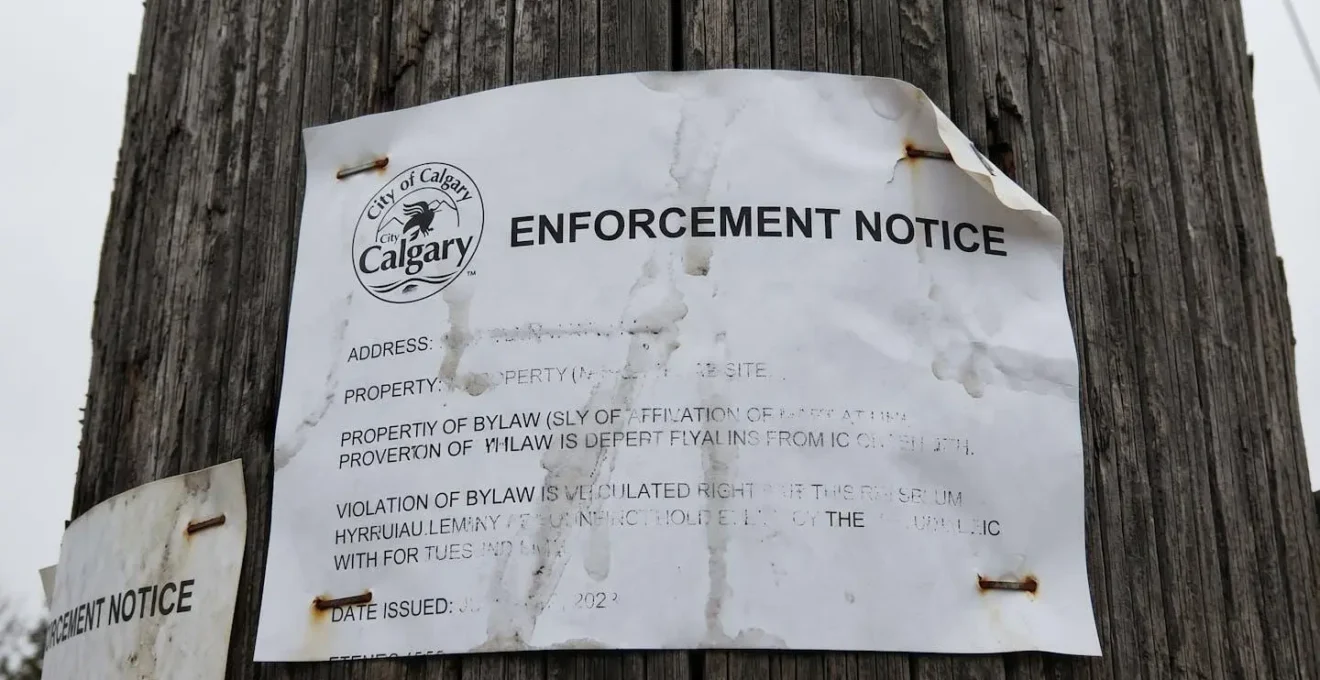
Calgary’s enforcement apparatus shifted from reactive complaint-driven response to systematic proactive patrol following the 2024 bylaw amendments. Before April 2024, service request processing averaged three weeks; current response timelines sit at two days, reflecting dedicated resource allocation and digital complaint integration. The City received over 2,000 signage-related service requests in the 12 months following the regulatory update, demonstrating heightened public awareness and enforcement expectations. This accelerated cadence compresses the window between placement and penalty, leaving minimal margin for correction before fines apply.
11,400 signs removed
Calgary enforcement removed this volume of non-compliant temporary signage in a single year while impounding 1,215 repeat violations
Financial penalties operate on a tiered structure. Baseline infractions—unauthorized placement on city property without aggravating factors—trigger CAD$75fines. Violations in high-sensitivity zones (School Zones, Playground Zones, transit infrastructure proximity) escalate to CAD$250 to CAD$500 range. Repeat offenders or signs creating safety hazards (obstructing sightlines, blocking pedestrian passage, positioned near fire hydrants) face maximum CAD$1,000 penalties. These amounts exclude impoundment retrieval fees when the City physically removes and stores signs, adding administrative costs that can double the total financial impact for businesses slow to respond to initial notices.
Enforcement follows a documented escalation path. Initial violations in lower-risk zones may generate warning notices allowing 48-hour voluntary removal before fines apply, though this discretion varies by inspector and location sensitivity. Signs on municipal sidewalks during peak pedestrian hours or in complaint-driven scenarios typically bypass warnings, proceeding directly to removal and fine issuance. The 95 per cent compliance rate achieved citywide suggests enforcement credibility—businesses recognize that non-compliance carries near-certain consequences rather than probabilistic risk. This shifts the calculation from « will I get caught? » to « how do I operate within constraints? », fundamentally altering signage strategy from placement optimization to regulatory navigation.
Securing compliant signage without the guesswork
Navigating Calgary’s signage framework demands either substantial internal expertise or external professional guidance. Bold Signs & Graphics provides comprehensive consultation services addressing property boundary verification, bylaw interpretation, permit application coordination, and placement strategy tailored to business visibility goals while guaranteeing regulatory compliance. While professional consultation requires upfront investment, it eliminates costly trial-and-error cycles and reduces the risk of violations that can quickly exceed service fees.
- Confirm property ownership status through land title search or property assessment records
- Obtain written landowner permission with placement location, duration, and removal responsibility specified
- Measure and document setback distances from vehicle access (7.5m), intersections (15m), transit infrastructure (30m), fire hydrants (2m), crosswalks (10m)
- Verify sign dimensions against 1.5 square metre threshold requiring Class E development permit
- Check temporary sign marker approval status if using designated mounting point on private property
- Confirm sign displays event dates within 14-day pre-event window and plan removal within 24 hours post-event
- Photograph placement location with visible landmarks and measurement documentation for compliance records
Professional signage providers handle permit applications, a process requiring technical drawings, site plans, and compliance declarations that consume substantial time for businesses lacking in-house planning expertise. Class E development permits for signs exceeding 1.5 square metres involve review cycles that typically require advance planning to meet campaign deadlines, with processing times varying based on application completeness. Outsourcing this process to providers experienced with Calgary’s approval workflow reduces rejection risk and accelerates deployment.
Once compliant signage operates, performance measurement becomes essential. Tracking foot traffic changes, promotion redemption rates, and customer acquisition costs against signage investment determines whether constrained placement still delivers acceptable returns. Businesses increasingly apply structured analytics to temporary signage campaigns, with measuring the ROI of campaigns becoming standard practice for optimizing future placements and justifying ongoing rental costs against digital advertising alternatives.
Can I place an A-frame sign on the sidewalk in front of my Calgary storefront?
No. Calgary sidewalks constitute city-owned property where commercial signage is strictly prohibited under Temporary Signs on Highways Bylaw 29M97. Even if the sidewalk sits directly in front of your leased space, municipal ownership extends from the curb to the building face in most commercial districts. Placement requires identifying private property within your control, typically building entrance areas or privately owned forecourts, while respecting 7.5-metre setbacks from vehicle access points.
My competitor has signs everywhere—how is that legal?
Apparent widespread placement often reflects either private property agreements you cannot observe (parking lot owner permissions, multi-location landlord relationships) or temporary compliance during the brief window before enforcement response. Calgary’s two-day average response time means non-compliant signs may remain visible for 48 to 72 hours before removal. Alternatively, competitors may have secured Class E development permits for designated temporary sign markers on private land, an investment creating ongoing legal placement capacity.
How quickly will I face fines if I place a sign incorrectly?
Following 2024 bylaw amendments, Calgary reduced enforcement response from three weeks to two days. High-traffic commercial areas and complaint-driven scenarios often see same-day or next-day action. Signs creating safety concerns (sightline obstruction, pedestrian passage blocking) or placed in sensitive zones (schools, playgrounds, transit infrastructure) trigger immediate removal without warning periods. Lower-risk violations may receive 48-hour correction notices before fines apply, though this remains inspector discretion rather than guaranteed process.
Do I need a permit for temporary signs on my own private property?
It depends on sign size and placement method. Temporary signs under 1.5 square metres placed on approved temporary sign markers on private property generally do not require development permits, provided the marker itself received prior approval and designation. Signs exceeding 1.5 square metres trigger mandatory Class E development permit applications regardless of property ownership. Additionally, temporary sign markers cannot be placed on major roadways or pedestrian-oriented areas as defined in Land Use Bylaw 1P2007, creating zones where even private property carries placement restrictions.
What exactly counts as city property versus private land in Calgary?
City property encompasses road rights-of-way (including sidewalks, boulevards, and traffic medians), parks, publicly maintained green spaces, and municipally owned infrastructure corridors. Property boundaries are legally defined in land titles, accessible through Alberta Land Titles registry searches. Visual assumptions often mislead—many sidewalks extend several metres from curbs onto what appears to be commercial frontage but remains municipal jurisdiction. Businesses should verify boundaries through land title confirmation or professional survey rather than relying on apparent control or lease perceptions.
Can I display temporary signs for longer than 14 days before an event?
No. Calgary bylaw limits commercial temporary signage advertising specific events to a maximum 14-day pre-event display window. Signs must be removed within 24 hours following the advertised event conclusion. This restriction applies to event-specific messaging (grand openings, sales promotions, limited-time offers with defined end dates). Non-event general advertising faces different regulations under Land Use Bylaw 1P2007 governing permanent and semi-permanent signage, which typically require development permits and differ from temporary rental sign frameworks.
Calgary’s regulatory environment will continue tightening as the City refines enforcement technology and public reporting mechanisms. Businesses treating signage compliance as an operational competency rather than an obstacle position themselves to maintain visibility advantages while competitors cycle through violation-correction loops that damage brand perception and drain marketing budgets through cumulative fines.